


When the Pavement Looks Fine but Isn’t: What a Black Ice Risk Score Really Tells You

A Number Is Useful Only If You Know What Is Behind It
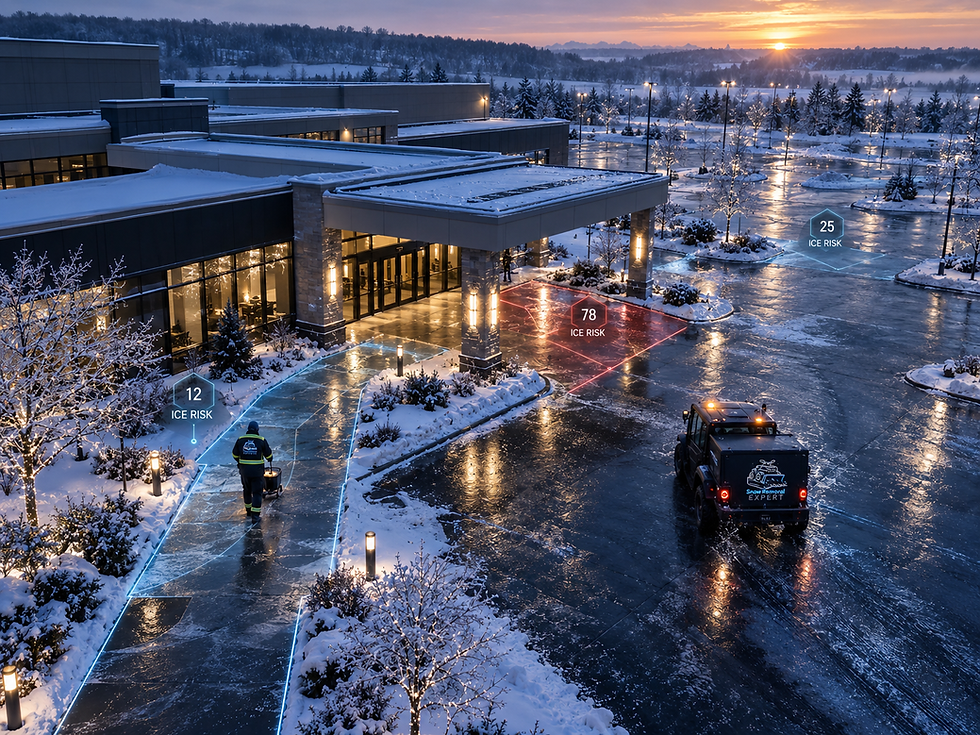
A parking lot can look wet at 4:00 p.m. and become an ice concern before the evening shift arrives. That gap between what a property looks like now and what it may become next is where a black ice risk score becomes useful.
A black ice risk score is best understood as a decision-support indicator, not a universal industry formula. Depending on the monitoring system, it may combine weather observations, forecasts, pavement or surface-temperature information, moisture conditions, precipitation, temperature trends, and known characteristics of a property into a simplified risk level.
For a coastal property, covered commercial entrance slush monitoring illustrates why one citywide forecast is not enough. A Vancouver entrance can receive slush from vehicles and foot traffic even after exposed pavement begins drying. Water may remain around the sheltered threshold, where sunlight, wind, and drainage behave differently.
Federal Highway Administration guidance supports this broader approach to winter decisions: pavement temperature, precipitation type and rate, humidity, dew point, and surface condition can all matter when assessing frost and black-ice potential. Pavement temperature is particularly important because it can lag behind changes in air temperature.
The score's job is to make those changing inputs easier for an operations team to notice and act on.
It is not supposed to replace looking at the pavement.
How Risk Thresholds Can Guide Winter Decisions
A useful score should help answer an operational question: Does this property need attention now, soon, or not yet?
Consider chinook-cycle parking ramp ice management in Calgary. A period of warmer weather can soften snow and create runoff. The concern may increase later if temperatures fall while water remains on a shaded or sloped ramp.
A risk model could recognize that changing combination and move the site from a routine-monitoring category toward an inspection or treatment threshold.
The actual thresholds do not have to be universal. One system might display low, moderate, and high risk. Another could use a numerical scale. What matters is that the meaning behind each level is defined operationally.
For example, a higher score might prompt the dispatcher to review a site's recent conditions, confirm whether moisture is present, and determine whether an inspection should be advanced. A lower score might mean no immediate action but continued monitoring.
This is much more useful than treating every temperature near 0°C as an automatic service call.
Road-weather systems already use combinations of conditions rather than temperature alone. World Meteorological Organization guidance includes road-weather alarm examples combining road-surface temperature with moisture, recent precipitation, humidity, and the relationship between surface temperature and dew point.
The Inputs Behind an Ice-Risk Decision
For facility teams, the score itself matters less than the information feeding it.
At an Edmonton industrial property, deep-cold service road ice preservation presents a different operating problem from a coastal entrance or a Chinook-affected ramp. Persistent cold can keep compacted snow, residual moisture, and treated surfaces in winter conditions for extended periods.
A good monitoring framework therefore needs both weather information and site context.
Weather Inputs Show What Is Changing
Useful inputs can include air temperature, pavement or surface temperature where available, forecast temperature trend, humidity, dew point, precipitation type, wind, and recent precipitation.
FHWA examples of mobile road-weather monitoring have used sensors measuring relative humidity, dew point, ambient temperature, and road temperature to help operators decide when treatment may be needed for freezing-fog conditions associated with black ice.
A single measurement is rarely enough.
A pavement sitting at 1°C and drying may deserve a different response from pavement at the same temperature with standing moisture and rapidly falling temperatures.
Property Inputs Explain Where Risk Concentrates
Weather data does not know that the north entrance stays shaded until noon.
It does not automatically know that one downspout empties beside the loading walkway, that a ramp lies below an uphill snow-storage area, or that vehicles repeatedly carry slush into a covered entrance.
Those characteristics belong in the operational picture.
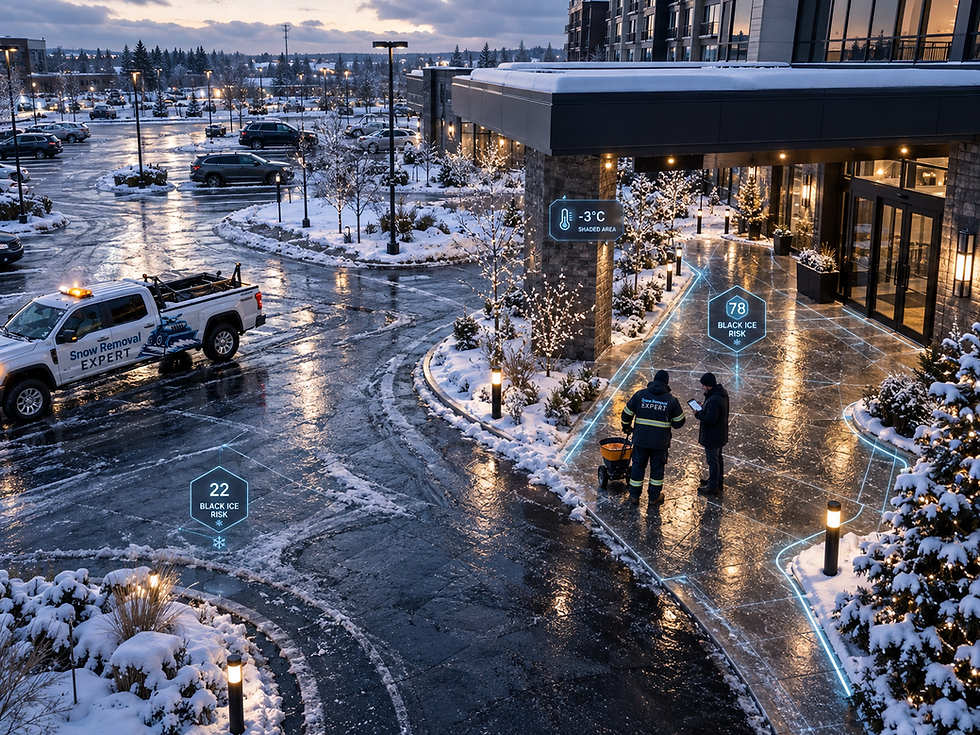
The most useful risk system therefore works zone by zone rather than treating an entire property as one surface.
The Score Should Start a Decision, Not Finish It
This is the most important limitation.
A risk score is not proof that black ice exists. It is also not proof that a property is safe when the score is low.
Sensors can have limitations. Forecasts change. Moisture can be highly localized. A blocked drain, leaking downspout, shaded corner, or vehicle carrying slush into a garage may create conditions that regional weather data cannot fully capture.
Even pavement sensing has measurement limitations. FHWA notes that infrared pavement-temperature sensors can be affected by calibration, surrounding heat sources, road splash, snow, ice, and other material within the sensor's measurement area.
That is why Snow Removal Expert's Winter Intelligence Engine should be viewed as support for professional judgement and site inspection, rather than a replacement for either.
If a score rises, the next question is not simply, “Do we salt?”
It is, “What changed, where is the risk likely to be, and what does the property actually look like?”
Sometimes the correct response may be an inspection. Sometimes mechanical removal is needed first. Sometimes a specific icy zone needs treatment while the rest of the site requires nothing.
That distinction prevents weather intelligence from becoming automated guesswork.
From Alert to Dispatch: Where the Score Becomes Valuable
Risk information becomes useful when it changes what the operations team does.
Prioritize the Property, Then the Surface
Imagine that twenty properties are being monitored overnight.
Several may be approaching freezing temperatures, but one has recent precipitation, another has an exposed lot that has dried, and a third has a shaded ramp with known drainage problems.
Those sites should not necessarily receive identical priority.
A risk score can help dispatch identify which locations deserve review first. The team can then use property knowledge, live observations, recent service records, and professional judgement to decide what action is appropriate.
FHWA guidance for winter operations follows a similar principle: forecasts, radar, road-condition data, pavement temperatures, and approaching storm information should be assembled before deciding whether treatment is needed and when it should begin.
Use Follow-Up Checks When Conditions Keep Moving
The score can also help after crews leave.
A completed service visit does not freeze the property in time. Snowbanks melt. Traffic moves slush. Wind changes. Temperatures fall.
If monitored conditions deteriorate later, a site can return to the dispatch queue for another assessment.
That is particularly valuable for slopes, sheltered entrances, loading areas, drainage paths, and surfaces with a history of repeated refreeze.
Snow Removal Expert can pair this monitoring approach with fast, reliable clearing, modern equipment, 24/7 service capability, scheduled plans, and safety-focused ice control. The purpose is not to create more unnecessary visits. It is to make service decisions more targeted.
Better Winter Intelligence Means Fewer Assumptions
Traditional winter planning often begins with a simple trigger: snowfall is forecast, so crews prepare.
A black ice event is harder.
There may be almost nothing to plow. The important change can happen hours after precipitation ends, on only one part of the property.
That is where the Winter Intelligence Engine approach has its strongest value.
Instead of asking only, “Will it snow?”, property teams can ask:
Is the pavement trending toward freezing while moisture remains?
Which zones historically hold water or stay shaded?
Has recent snow clearing created new meltwater?
Has the risk changed enough to justify inspection?
What did the previous crew observe?
Does the site need treatment, mechanical work, or simply another check?
The answers still require human judgement.
But better inputs can reduce the number of decisions made from habit, a weather-app icon, or air temperature alone.
For property managers, that is the right way to think about a black ice risk score: not as a crystal ball, but as an early-warning layer that helps people decide where to look and when to act.


Comments