


One Truck, One Winter: How Much Can a Snow Removal Contractor Really Make?

One Truck Can Earn—but the Route Does the Math
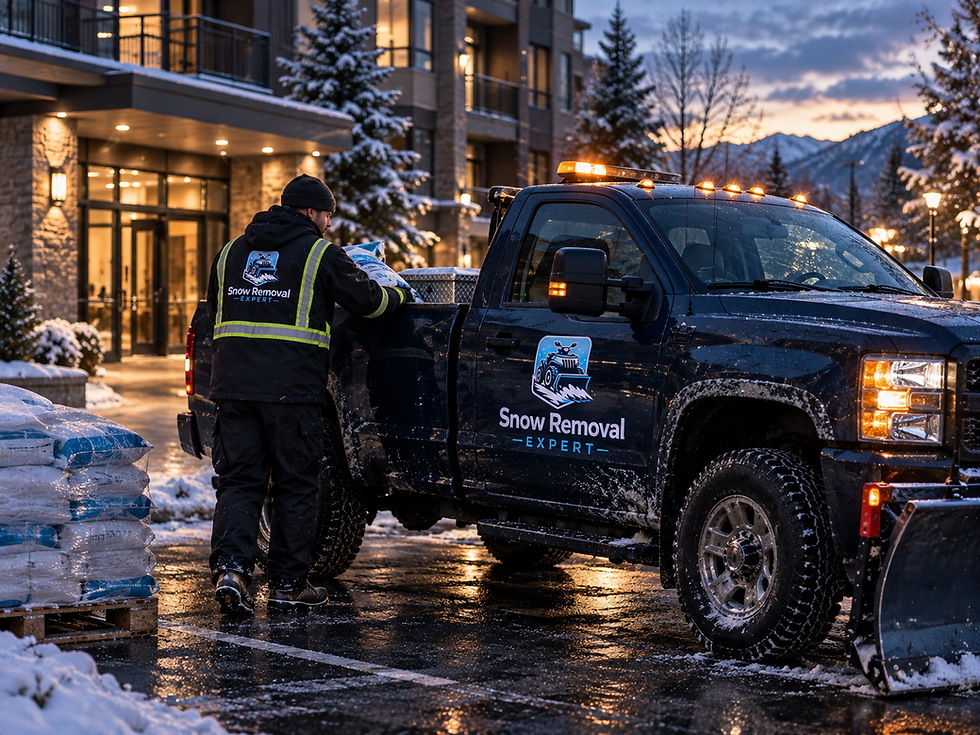
Owning a pickup with a plow does not automatically create a profitable snow business. The truck is only the production tool. What determines the season is how much useful, billable work that truck can complete before weather, distance, equipment limits, and operating costs start consuming the margin.
Consider an Edmonton route that includes cold-soaked warehouse dock frost management alongside normal plowing. A contractor may have opportunities after the snowfall itself has ended because persistent cold, compacted snow, loading traffic, and icy access points can create additional service needs. That can make one account more valuable than a driveway that produces revenue only when accumulation reaches a trigger.
But revenue is not income.
A one-truck operator still has fuel, maintenance, insurance, equipment, travel time, repairs, bookkeeping, and potentially ice-control materials to cover.
Some online estimates blur that distinction. Aspire's 2026 snow-removal business guide, for example, reports broad owner-income figures but also notes that earnings depend on regional weather, contract type, profitability, and business scale. It specifically distinguishes established multi-truck businesses from newer and individual operators—an important limitation when estimating what one truck can produce.
The more useful question is therefore not, “What does a snow contractor make?”
It is, “What can this truck produce on this route, under these assumptions?”
Warm Spells Can Create Work Too
Snowfall is only one revenue driver.
In Calgary, a route may face conditions where chinook-driven rooftop parkade refreeze tracking becomes as operationally important as the original plowing. Snow softens, drainage begins, water travels across a ramp or parking surface, and colder conditions later create another service decision.
That means a contractor's winter opportunity cannot always be estimated by counting snowstorms alone.
A mild-looking period can still produce salting, ice-control, inspection, or return-service requirements where contracts authorize that work.
This matters when comparing Edmonton and Calgary opportunities. Edmonton's 1991–2020 climate normals show January and December daily averages well below freezing, illustrating the persistent cold environment contractors may face there. Calgary, meanwhile, is well known operationally for winter temperature swings, making the timing and type of work different even when the equipment looks similar.
Neither market automatically produces more profit.
The important issue is whether the route and contract structure allow the contractor to turn local winter conditions into efficient billable work.
Revenue Drivers for a One-Truck Operation
A useful income model starts with a few variables rather than an annual earnings headline.
Route Density and Property Mix
Route density may be the most underestimated factor.
Suppose two operators each have ten accounts. One can move between properties in five minutes. The other spends twenty minutes travelling between stops.
They do not really have the same route.
The first operator can spend more of the storm producing billable work. The second spends a larger share of the night burning fuel between jobs.
Property mix matters too. Residential driveways can be fast but may generate relatively small invoices per stop. Commercial properties can generate larger service values but may require more time, documentation, salting, loading-area work, sidewalks, or repeated visits.
A profitable one-truck route often depends on fitting work together rather than simply accumulating as many customers as possible.
Event Count and Additional Service
A simple model looks like this:
seasonal gross revenue = average billable value per event × number of serviced accounts × number of billable events, plus approved additional work.
For illustration only, imagine 12 tightly grouped accounts averaging $140 of truck-related work during 18 billable events. That would produce $30,240 in gross seasonal revenue before costs.
If the same route also generates approved ice-control or follow-up work, gross revenue could increase. If only eight events occur, revenue could fall sharply.
The numbers are not a forecast. They demonstrate why advertised annual earnings without assumptions are nearly meaningless.
Operating Costs That Reduce Take-Home Income
Gross revenue can look impressive from the driver's seat. Net income looks different once the truck reaches the shop.
Fixed and Seasonal Costs
Commercial insurance, licensing requirements, plow equipment, lighting, communications, administrative systems, and other business overhead exist whether the winter becomes active or quiet.
Equipment financing can be particularly important for a first-year contractor. A new plow or spreader may improve capability, but the payment does not disappear during a mild month.
Contractors should also confirm insurance, vehicle, licensing, tax, and contractual requirements applicable to their own business rather than relying on generic online advice.
Costs That Rise With Every Storm
Fuel is obvious. Wear is less visible.
Plowing creates demanding operating conditions for tires, suspension, steering components, electrical systems, hydraulics, transmissions, blades, cutting edges, and the truck itself.
Then there is salt or other approved material, depending on who supplies it and how the agreement is structured.
Even labour has a cost when the owner drives alone. Twelve hours in a truck is twelve hours that cannot be spent elsewhere.
A sensible contractor model therefore calculates revenue per productive truck hour, not just revenue per storm.
That number exposes routes that look busy but are not especially profitable.

Downtime Is the Number Nobody Brags About
The biggest earning opportunity can disappear with one mechanical problem.
A one-truck operation has limited redundancy. If the truck cannot work, the operator may have no second unit available to complete the route.
That makes preseason inspection, spare parts, preventative maintenance, and realistic route capacity part of the income calculation.
There is also operational downtime that has nothing to do with repairs.
Waiting for access gates, doubling back because properties are scattered, sitting in traffic, loading material inefficiently, or receiving incomplete dispatch information all consume the same winter hours that could have generated revenue.
This is where working within an organized contractor network can be valuable.
Snow Removal Expert builds winter operations around reliable clearing, modern equipment, 24/7 service capability, safety-focused ice control, scheduled plans, and clear service expectations. For contractors, the practical advantage of a coordinated operation is not a guaranteed income figure. It is the opportunity to spend more time completing properly assigned work and less time trying to assemble an entire winter business from scratch.
How to Evaluate a Contractor Opportunity
Before asking what one truck can make, ask what the opportunity actually gives that truck to do.
Look at expected property density, typical route length, payment structure, service triggers, ice-control opportunities, documentation requirements, material responsibility, equipment expectations, and what happens when weather creates repeat visits.
Season length matters too. So does the number of billable events. One profitable storm cannot tell you what the season will look like.
More importantly, calculate several outcomes rather than one optimistic projection.
Run a mild-winter scenario. Run an average working assumption. Then run a high-activity scenario that includes additional fuel, maintenance, material use, and wear.
If the economics only make sense in the busiest scenario, the business model is fragile.
One truck can absolutely be the beginning of a winter contracting operation. But the truck itself is not the business. The route, utilization, service mix, weather, cost control, and reliability determine what the equipment can actually produce.
For pickup owners who already have suitable equipment and want to put winter capacity to work, the next step is to evaluate the route opportunity rather than chase an advertised earnings number.
Apply to become a Snow Removal Expert contractor and evaluate whether your truck, availability, equipment, and local service area fit the contractor network. Earnings vary by assignment, weather, costs, availability, and actual work completed; no seasonal income is guaranteed.


Comments