


When the Snow Has Nowhere Left to Go: The Point Where Plowing Is No Longer Enough

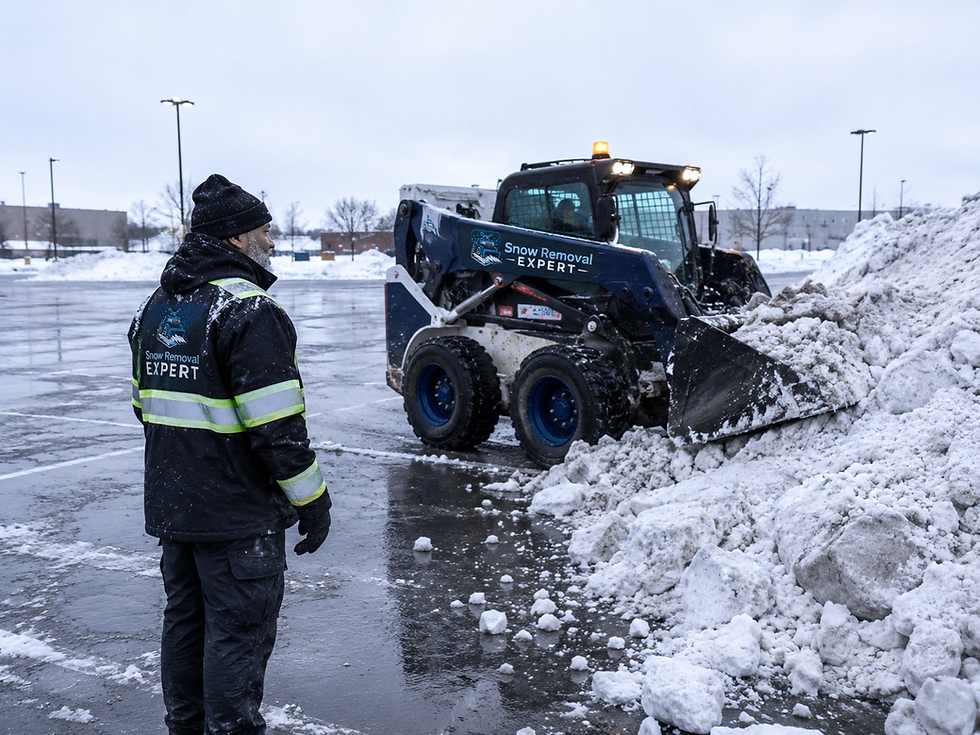
When a Snow Pile Starts Creating the Next Problem
On-site plowing is usually the most efficient way to handle snow because the material only needs to be pushed from active pavement into designated storage areas. The problem begins when those storage areas stop functioning as storage and start interfering with the property.
The first warning is often not pile height. It is what happens around the pile.
On Calgary properties, chinook-driven meltwater refreeze control can become part of the decision because a pile that was stable during colder weather may release substantial meltwater when temperatures rise. If that water crosses a drive aisle, pedestrian route, ramp, or shaded surface before freezing again, keeping the snow on-site may create repeated maintenance demands.
The City of Calgary specifically notes that snowmelt from commercial and industrial areas can carry material into storm drains and recommends managing the volume and rate of runoff leaving a site.
That illustrates an important point: snow hauling is not simply about appearance. Sometimes removing stored snow protects the function of the property after the plowing itself is finished.
Property managers should watch what the pile is doing—not just how large it looks.
Snow Storage Capacity and Site Access
A property technically still has storage capacity if another loader bucket can fit onto a pile. Operationally, however, capacity may already be exhausted.
For sites managing extreme-cold pedestrian route traction planning, especially during Edmonton winters, keeping snow on-site can progressively narrow the zones available for safe pedestrian movement. A pile may force a sidewalk connection inward, reduce the width of a crossing, or create compacted snow where pedestrians step around it.
The City of Edmonton operates dedicated snow-storage facilities and is upgrading several of them specifically to improve storage capacity, drainage, meltwater control, monitoring, and site access. That is a useful reminder that snow storage itself requires infrastructure and management; it is not simply empty ground where material can be left indefinitely.
For a commercial property, storage capacity should therefore be measured against usable space.
Managers should monitor whether piles are beginning to consume parking stalls, vehicle turning areas, loading approaches, pedestrian connections, drainage paths, or backup storage zones needed for the next storm.
One useful question is simple: If another significant snowfall arrives tomorrow, where will that snow go?
If the answer requires blocking something important, hauling should already be under consideration.
The Hidden Cost of Keeping Snow on the Property
Snow hauling costs more upfront than simply pushing material to the edge of a lot. But leaving snow in place can create costs of its own.
Visibility and Parking Can Disappear Gradually
A pile near an internal intersection may initially be low enough to see over. After three more events, it may conceal an approaching vehicle or pedestrian.
Parking capacity can disappear in the same gradual way. A few stalls sacrificed during the first storm may seem insignificant. Later storms may consume another row, narrow circulation, or leave no room for equipment to maneuver effectively.
That is why a fixed pile-height threshold is often less useful than an operational threshold.
Hauling may become appropriate when storage begins affecting sightlines, traffic flow, customer parking, employee access, or the ability of equipment to clear the next event properly.
Accessible and Emergency Areas Are Not Overflow Storage
Accessible stalls, access aisles, curb transitions, fire routes, hydrant approaches, and emergency access should not become secondary snow-storage areas simply because primary zones are full.
The same applies to loading docks and service entrances.
Once piles begin pushing toward protected or essential areas, the decision is no longer about maximizing storage efficiency. The property is trading functional access for temporary snow capacity.
That is usually a strong signal that some material needs to leave the site.
Comparing the Cost of Plowing and Hauling
The snow hauling vs plowing decision becomes easier when managers compare complete operational costs rather than only contractor invoices.
Plowing Is Usually the First Step
Hauling does not replace plowing.
Crews still need to clear active pavement and consolidate snow into locations where loaders can handle it. Hauling is normally a downstream step used when the accumulated material can no longer remain where it has been stored.
That is why automatically hauling after every snowfall is rarely economical for a property with adequate storage.
On the other hand, waiting until every storage zone is completely full can make removal more complicated. Equipment may have less room to work, piles may become harder to access, and parking or loading areas may already be compromised.
Think in Terms of Avoided Disruption
The useful calculation is not simply:
plowing cost versus hauling cost.
It is hauling cost versus the consequences of keeping the snow.
Those consequences can include lost parking, repeated ice-control visits, restricted delivery access, difficult maneuvering, reduced sightlines, drainage problems, resident or tenant complaints, and slower clearing during the next storm.
Transparent pricing matters here. Snow Removal Expert can help property managers establish expectations for scheduled clearing and discuss changing site conditions before snow-storage pressure becomes an emergency. Fast response, modern equipment, 24/7 availability, and safety-focused ice control are most valuable when paired with a plan that identifies when ordinary stacking is no longer enough.

One More Storm Can Change the Calculation
Snow-storage decisions should consider the forecast, not merely current conditions.
A property may look acceptable today while having almost no reserve capacity.
If a significant storm is expected within 48 hours, hauling part of an existing pile can restore valuable operating room before the next clearing cycle begins. That may be more efficient than waiting until crews are trying to stack new snow onto an already constrained site.
Repeated storms also change the physical character of piles. Snow can compact, accumulate road debris, develop frozen sections, or repeatedly release meltwater.
Drainage is especially important.
The City of Edmonton's winter-design guidance recommends accounting for spring runoff from snow-storage areas in site drainage planning and directing drainage containing contaminants away from natural areas.
For commercial properties, the immediate version of that principle is straightforward: determine where meltwater from every major storage zone will travel.
If the answer points toward a storefront, pedestrian crossing, loading area, parkade ramp, or frequently used drive lane, retaining a very large pile may create more work than removing part of it.
Assess Snow Storage Capacity Before It Is Gone
The best time to decide when to haul snow is not when the loader has nowhere left to push it.
Walk the property before winter and identify the true storage capacity of each zone. Account for drainage, sightlines, pedestrian routes, accessible parking, fire access, loading operations, landscaping, utilities, and the equipment space required to manage the pile itself.
Then establish hauling triggers based on operations rather than one arbitrary measurement. A practical plan may call for reassessment when:
primary storage zones approach their usable limit;
piles begin consuming required parking or circulation space;
sightlines deteriorate;
accessible or emergency routes face encroachment;
runoff repeatedly creates icing problems;
or forecast accumulation is greater than the property's remaining storage reserve.
Snow Removal Expert can incorporate those considerations into scheduled winter planning rather than treating hauling as an unexpected last-minute decision. Reliable clearing keeps the site operating during storms, while ongoing assessment helps determine whether the accumulated material can safely remain.
The cheapest option after one snowfall is often to leave the snow where it is.
The better decision over an entire winter is to know exactly when keeping it there becomes more expensive, disruptive, or difficult than taking it away.
Assess snow storage capacity before the next major storm and establish clear operational thresholds for when on-site plowing should transition to snow relocation or hauling.


Comments